

The Problem
The scene every hospital already knows
The doctor gave the discharge order at 10 AM. It is 4 PM. The patient is still in the bed.
You ask nursing. Nursing says billing hasn't cleared. You ask billing. Billing says pharmacy hasn't confirmed the drug return. You ask pharmacy. Pharmacy says they never got the notification.
Nobody dropped the ball on purpose. Everyone was doing their job. And yet — the discharge didn't happen. This is not an unusual day. This is every day. And it has a name.
The Root Cause
Every department owns a task. Nobody owns the journey.
The delay wasn't discovered. It was inherited.
Discharge is not one task. It is a relay across eight departments — Consultant, Nursing, Pharmacy, Billing, Insurance, Diagnostics, Housekeeping, Transport.
Drop the baton once and every downstream step inherits the delay. The medically fit patient keeps the bed. The next admission waits. Nurses spend the afternoon on follow-up calls instead of patient care.
This isn't unique to your hospital. It has been observed in healthcare systems across the world for more than two decades.
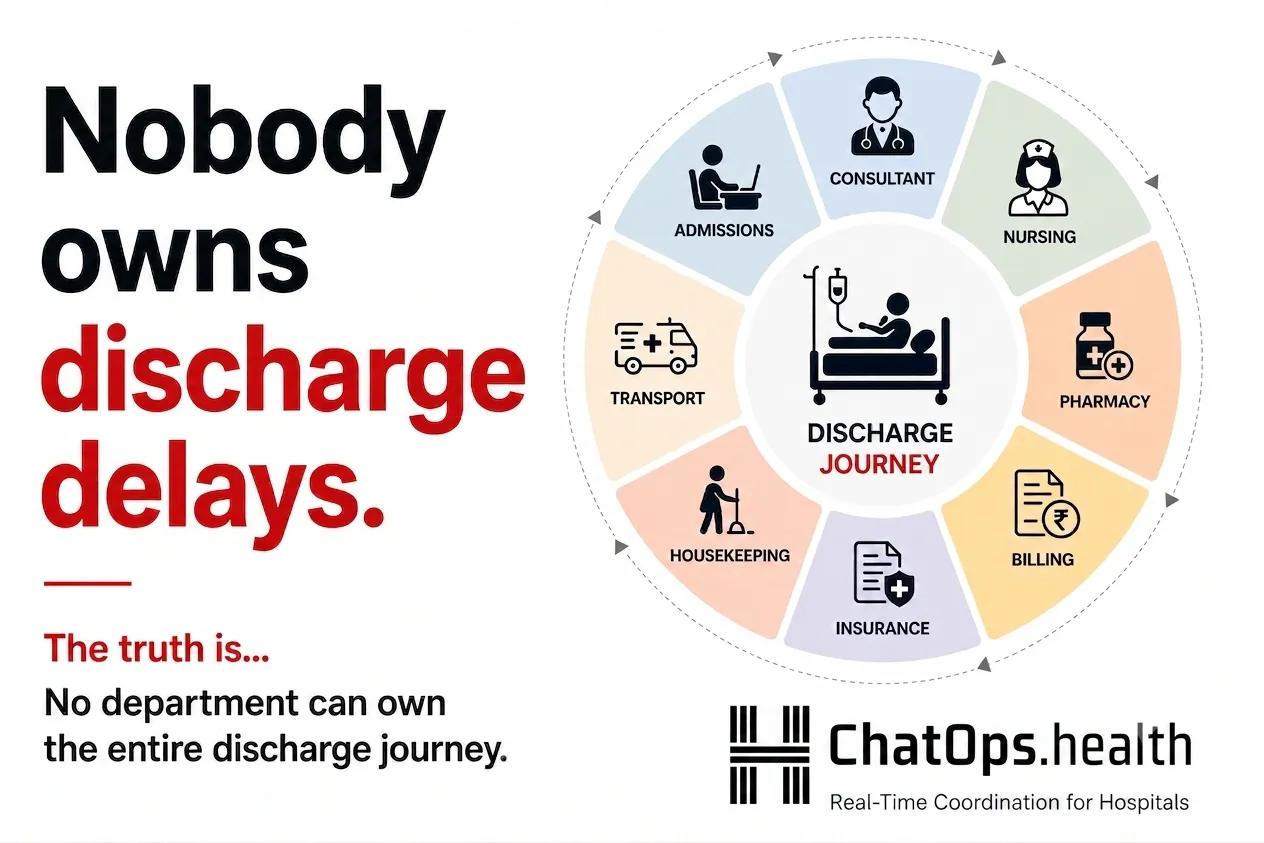
Discharge is a relay across eight departments. Nobody owns the handoff between tasks — and that gap is where every delay lives.
The Evidence
Note: This article focuses on the operational coordination that begins after the treating doctor decides a patient is fit for discharge. Clinical decision-making, medical readiness for discharge, and treatment-related delays are outside the scope of this discussion.Twenty years of research. Same root cause.
The research on hospital discharge delays is not ambiguous. Across different countries, different health systems, and different decades — the finding is consistent: the root cause is not clinical complexity. It is coordination failure.
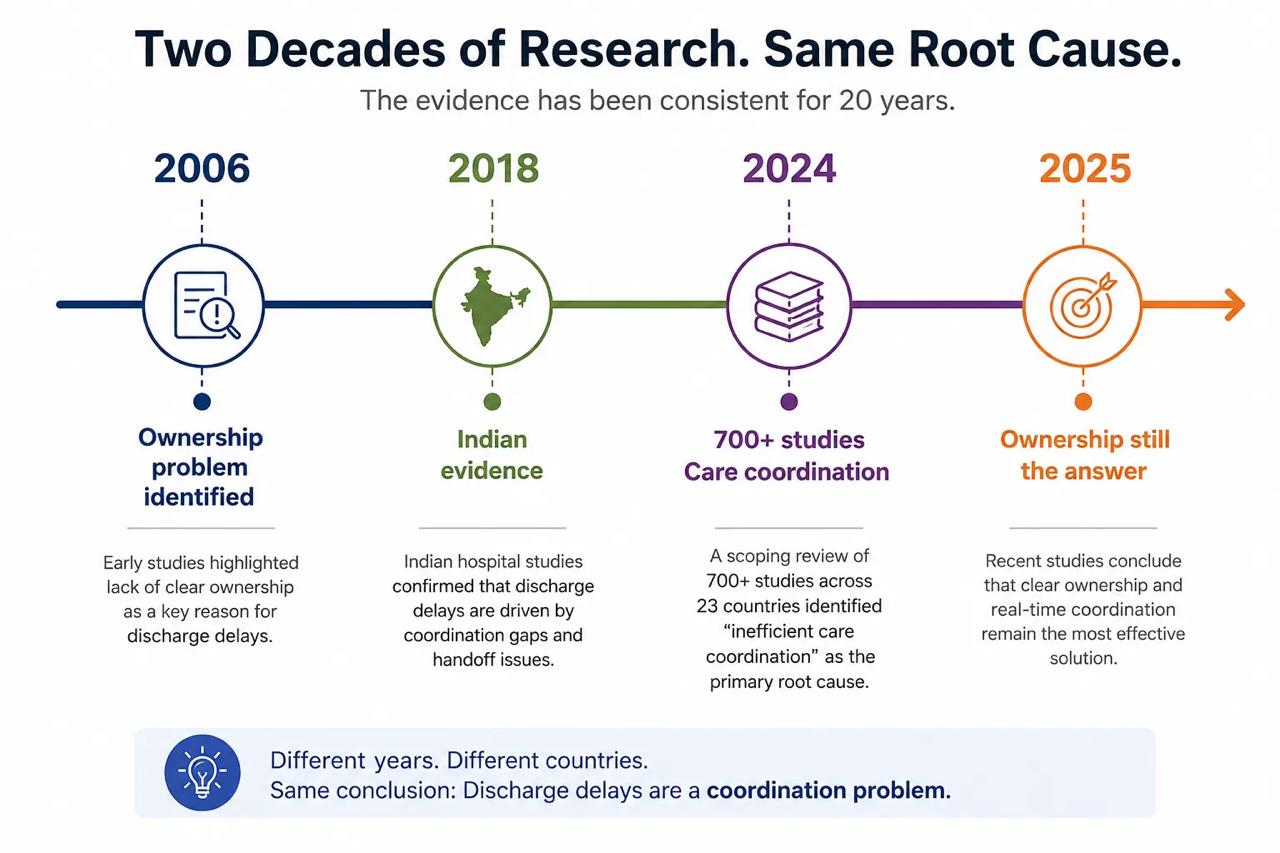
From 2006 to 2025: different years, different countries, same conclusion.
A 2024 scoping review in Health Expectations synthesised 23 review papers covering 700+ studies. Its finding: inefficient care coordination is still the primary root cause — above staffing, above technology, above clinical factors.
A 2025 study found that most delays are not due to unresolved clinical issues. They happen because of communication breakdowns and unclear ownership.
In January 2024, the NHS reported 14,436 patients a day remaining in hospital despite being medically ready to leave — 30% higher than three years prior. Not clinical complexity. Coordination failure.
In India, a 2024 study found discharge delays caused by incomplete files, HIS discrepancies, and missing information flow between departments. A 2018 Pune hospital study found insured patient TAT is consistently higher — with pending evaluations and inter-department handoffs as the dominant factors.
Different years. Different countries. Same conclusion: discharge delays are a coordination problem.
What's Been Tried
Hospitals haven't ignored this problem.
They've hired discharge coordinators.
They've introduced morning discharge rounds.
They've implemented Lean projects.
They've created escalation matrices.
They've formed WhatsApp groups.
They've redesigned SOPs.
Every intervention improves coordination for a while. But eventually the process depends on people remembering to follow up. And people are already busy delivering care.
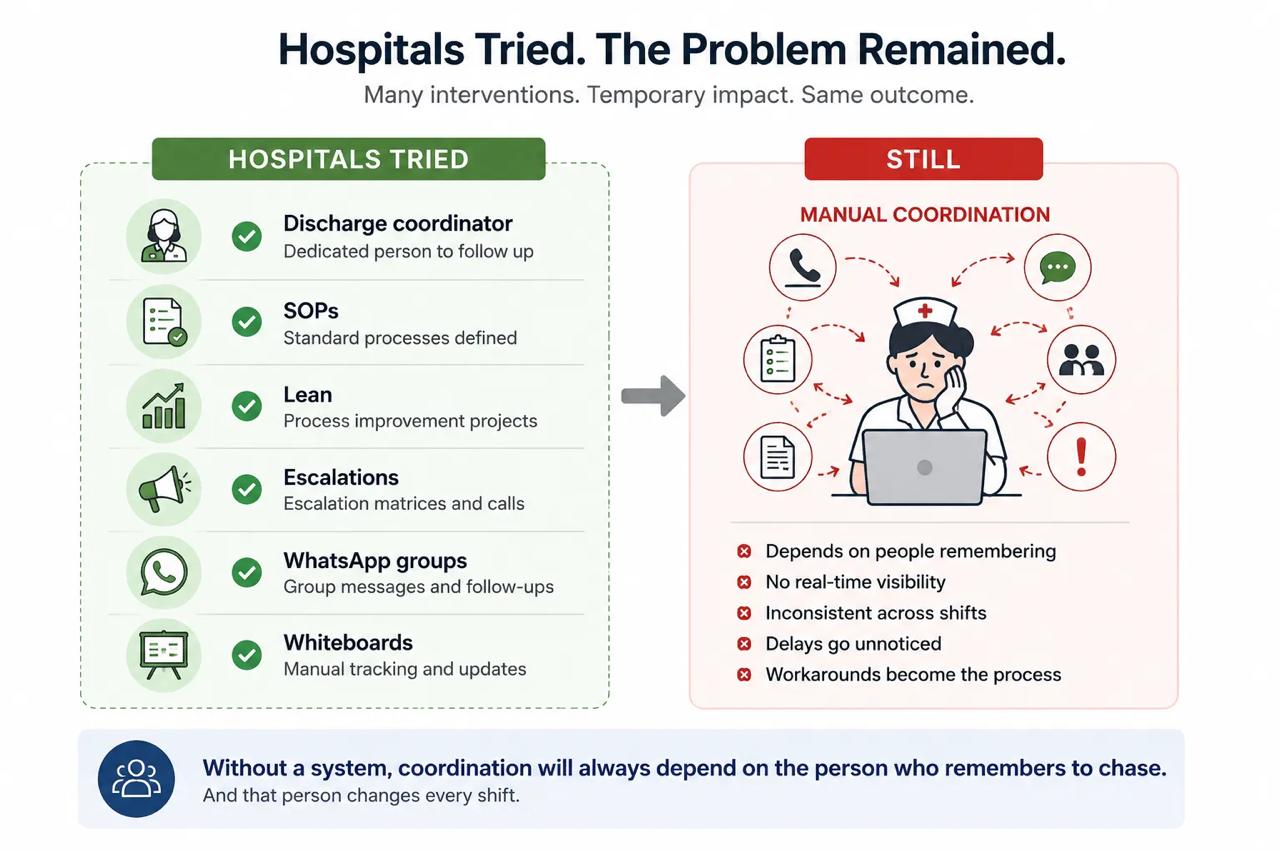
Many interventions. Temporary impact. The same outcome: manual coordination, inconsistent across shifts.
Without a system, coordination will always depend on the person who remembers to chase. And that person changes every shift.
The Missing Layer
Your HMIS is not the problem. And it's not the solution either.
Your Hospital Management System is doing exactly what it was built to do — recording what happened, who completed it, and when.
But ask your HMIS what is stuck right now, with whom, and since when — and it goes silent.
Recording work and coordinating work are two different jobs.
Every hospital has a System of Record.
Almost no hospital has a System of Coordination.
This isn't a flaw in your HMIS. It was never designed to coordinate work in real time. So when no system does — people become the system.
Nurses chase instead of care. Quality teams follow up instead of improve. Administrators track down departments instead of running the hospital. The hidden cost isn't just the delayed bed — it's everything your team could have done instead.
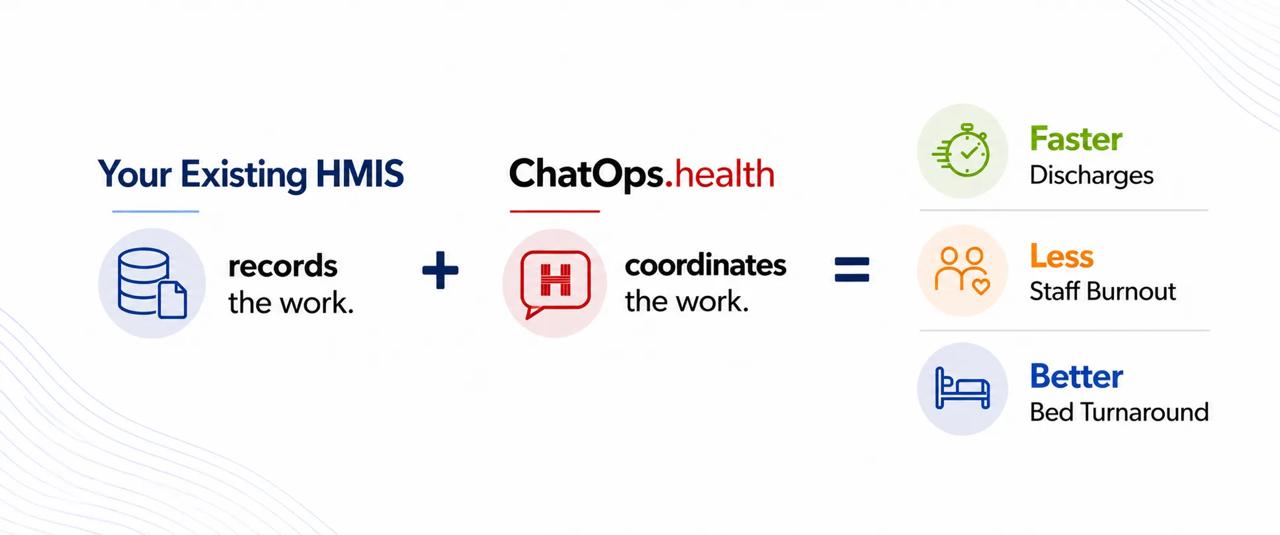
HMIS records the work. ChatOps.health ensures it gets done — in real time, on WhatsApp.
The Fix
What coordination actually requires — in real time
For discharge to move without chasing, six questions need an answer the moment each task begins.
| Question | Most hospitals today | With ChatOps.health |
|---|---|---|
| Who owns this task? | The department | Named individual |
| Have they acknowledged it? | ✗ Unknown | ✓ Confirmed |
| Is there a defined TAT? | ✗ Assumed | ✓ Clock starts on assignment |
| Reminder before TAT breach? | ✗ Someone calls | ✓ Automatic |
| Escalation on TAT breach? | ✗ If someone notices | ✓ Automatic, every time |
| Next department auto-notified? | ✗ Another phone call | ✓ Triggered on completion |
No system in most hospitals answers these questions in real time. Not HMIS. Not group WhatsApp. Not the discharge coordinator's notebook. That gap — between the process that exists and the coordination that doesn't — is where every discharge delay lives.
The Shift
What changes when coordination becomes system-driven
Before — Today
After — ChatOps.health
The right person receives the task. They acknowledge it before the clock starts. Reminders go out automatically — before TAT is breached, not after. Breaches escalate without anyone deciding to escalate. No new app. No IT integration. No training programme. Just WhatsApp — made accountable.
We don't replace HMIS. We don't replace WhatsApp. We replace the chasing.
Live Results
What hospitals see when this is in place
KIMS
Bhubaneswar · 2,500+ beds
1h 30m
Cash discharge TAT
VS Hospitals
Chennai · 300+ beds
90–95%
Discharges meeting TAT
Kongunad Hospitals
Coimbatore · 375 beds
Every
Delay documented with reason
Not because people worked harder. Because the system made coordination automatic — every task, every department, every shift.
Research References
The 10 papers every hospital should read on discharge delays
The most relevant published works on hospital discharge delays, coordination failure, TAT, and workflow tracking — curated for hospital operations leaders in India and globally.
2006 · United States
"Whose job is it anyway?"
The earliest documented evidence that lack of clear ownership was identified as the root cause of discharge delays. The conclusion: "somebody's got to own the process."
Today's Hospitalist · View paper →
2024 · Global · 700+ Studies
Decoding the Persistence of Delayed Hospital Discharge: A Scoping Review of Two Decades
Synthesises 23 review papers and 700+ studies across 23 countries. Identifies inefficient care coordination as the primary persistent root cause.
Health Expectations · View paper →
2025 · Global · 20 Studies
Reducing Delays, Improving Flow: The Importance of a Dedicated Discharge Coordinator
Concludes that the common denominator in every successful discharge intervention is clear ownership of the discharge process.
PMC / Cureus · View paper →
2025 · Global
Start With the End: Early Hospital Discharge Planning as a Day-One Priority
Finds that most discharge delays are not due to unresolved medical issues but to late-stage communication breakdowns and unclear ownership. Discharge is "too often approached reactively."
PMC / Cureus · View paper →
2025 · Global
Impact of Discharge Rounds on Patient Flow and Hospital Outcomes
States that discharge delays are a common and costly problem and that even structured discharge rounds have widely varying implementation. Even when hospitals try, there is no system.
PMC / Cureus · View paper →
2024 · NHS, United Kingdom
Impact of Accurate Discharge Planning on Discharge Delays
NHS data: 14,436 patients a day delayed despite being medically ready to leave — 30% higher than three years prior. If the world's most structured health system can't solve it, it is a coordination problem.
medRxiv · View paper →
2024 · India
Analysis of Time Taken for the Discharge Process
Insurance-related delays have a minimum 2-hour TAT floor. Non-TPA delays caused by incomplete files, HIS discrepancies, and missing information flow between departments.
Journal of Health Policy Research · View paper →
2018 · India, Pune
Predictive Modelling for Discharge TAT — Insured Patients
Discharge TAT for insured patients is consistently higher. Treating doctor availability and pending evaluations are the two dominant delay factors.
SAGE Journals · View paper →
2023 · Global
Healthcare Professionals' Perception of Barriers for Discharge Coordination
Nurses are "often exposed to heavy workload with little or no time to prepare patients for discharge." A dedicated coordinator facilitates the process — but this is "often not standard."
PMC · View paper →
2025 · Global
Exploring Delayed Discharges in an Acute Hospital
Frames delayed discharges as "a variable of significance when it comes to a health system's overall performance" — connecting bed space, discharge delays, and hospital-wide outcomes.
Hospitals / MDPI · View paper →
FAQ
Frequently asked questions on discharge delays
Why do hospital discharge delays happen?+
Discharge delays happen because no single department owns the entire discharge journey. Discharge is a relay across eight departments — Consultant, Nursing, Pharmacy, Billing, Insurance, Diagnostics, Housekeeping, and Transport. Each owns their task, but nobody owns the handoff between tasks. When a handoff fails silently, the delay is inherited by every downstream step. This is a coordination failure, not a staffing or technology failure.
Who owns discharge delays in a hospital?+
Nobody. Every department owns a specific task. No department owns the entire journey. When a delay occurs in the gap between tasks, there is no owner, no accountability, and no automatic escalation. The delay sits in the gap until someone notices or someone calls.
What does the research say about discharge delays?+
Twenty years of global research consistently identifies inefficient care coordination as the primary root cause. A 2024 scoping review synthesised 700+ studies across 23 countries and found the same conclusion. A 2025 study found most delays stem from communication breakdowns and unclear ownership — not clinical issues. Indian studies from 2018 and 2024 confirm the same pattern in domestic hospitals.
Why haven't hospitals fixed discharge delays despite trying for decades?+
Hospitals have tried discharge coordinators, morning rounds, Lean projects, escalation matrices, and WhatsApp groups. Each helps temporarily. None scale. Because they all depend on a person remembering to follow up — and that person changes every shift. Without a system, coordination will always depend on the individual who remembers to chase.
Why can't the HMIS fix discharge delays?+
The HMIS records what happened. It cannot answer what is stuck right now, with whom, and since when. Recording work and coordinating work are two different jobs. Most hospitals already run on HMIS and still experience persistent discharge delays — direct evidence that HMIS alone cannot solve the coordination problem.
What is the difference between a System of Record and a System of Coordination?+
A System of Record answers questions about the past: what happened, who completed it, when was it done. A System of Coordination answers questions about the present: what is stuck right now, with whom, since when, and what happens next. Every hospital has a System of Record. Almost no hospital has a System of Coordination.
What is Invisible Bed Occupancy?+
Invisible Bed Occupancy (IBO) is the period after a patient is medically cleared for discharge but before the bed is physically available for the next admission. The bed is neither occupied nor available — invisible to the system and untracked in most hospitals. IBO is a direct result of coordination failure.
How does ChatOps.health fix discharge delays?+
ChatOps.health assigns each discharge task to a named individual, confirms acknowledgement, tracks TAT automatically, sends reminders before delays occur, and escalates breaches automatically — all on WhatsApp Business Platform. It does not replace the HMIS. It does not replace WhatsApp. It replaces the chasing.
What results have hospitals seen with ChatOps.health?+
At KIMS Bhubaneswar (2,500+ beds), VS Hospitals Chennai (300+ beds), and Kongunad Hospitals Coimbatore (375 beds) — 90 to 95% of discharges meet the defined TAT. Every delay has a documented reason. Every discharge is measured end-to-end. KIMS benchmarks: 1h 30m for cash, 3h 30m for insurance.
How long does implementation take?+
ChatOps.health goes live in 24 hours. Share department staff phone numbers. Your workspace is configured the next day. No software installations, no IT integrations, no training sessions. Staff receive their first coordination task on WhatsApp and are operational immediately.
Does ChatOps.health replace the HMIS?+
No. It works alongside your existing HMIS without replacing or integrating with it. The HMIS remains your system of record. ChatOps.health ensures the work your HMIS has recorded actually gets done — in real time, with accountability, across all departments.
What is the pricing?+
₹8 per discharge coordinated for Indian hospitals. Minimum billing: 1,000 discharges per month. No per-bed or per-user licence. No capex. No integration project. No training programme.
In your hospital — who owns discharge delays?
If the answer is a list of departments, you have a coordination gap. See your own discharge TAT data for the first time in 14 days.
Start the 14-Day Outcome PilotLive in 24 hours · No software · No training · No commitment