

The Three Systems
The Modern Hospital Stack
Hospitals run on three distinct layers. Each has a different purpose. None substitutes for the other.
- Hospital Information System (HIS) — Administrative & revenue backbone.
- Electronic Medical Record (EMR) — Clinical record system.
- Hospital Coordination System (HCS) — The real-time coordination layer.
- · Doctor notes
- · Diagnoses
- · Treatment plans
- · Lab results
- · Prescriptions
Designed for clinical accuracy and patient safety.
- · Patient registration
- · Bed allocation
- · Service capture
- · Billing
- · Insurance documentation
Designed for operational record-keeping and revenue control.
- · TAT enforcement
- · Reminder engine
- · Escalation logic
- · Cross-department synchronization
- · Shared lifecycle visibility
This question rarely has a dedicated system.
Why HCS Must Be Separate
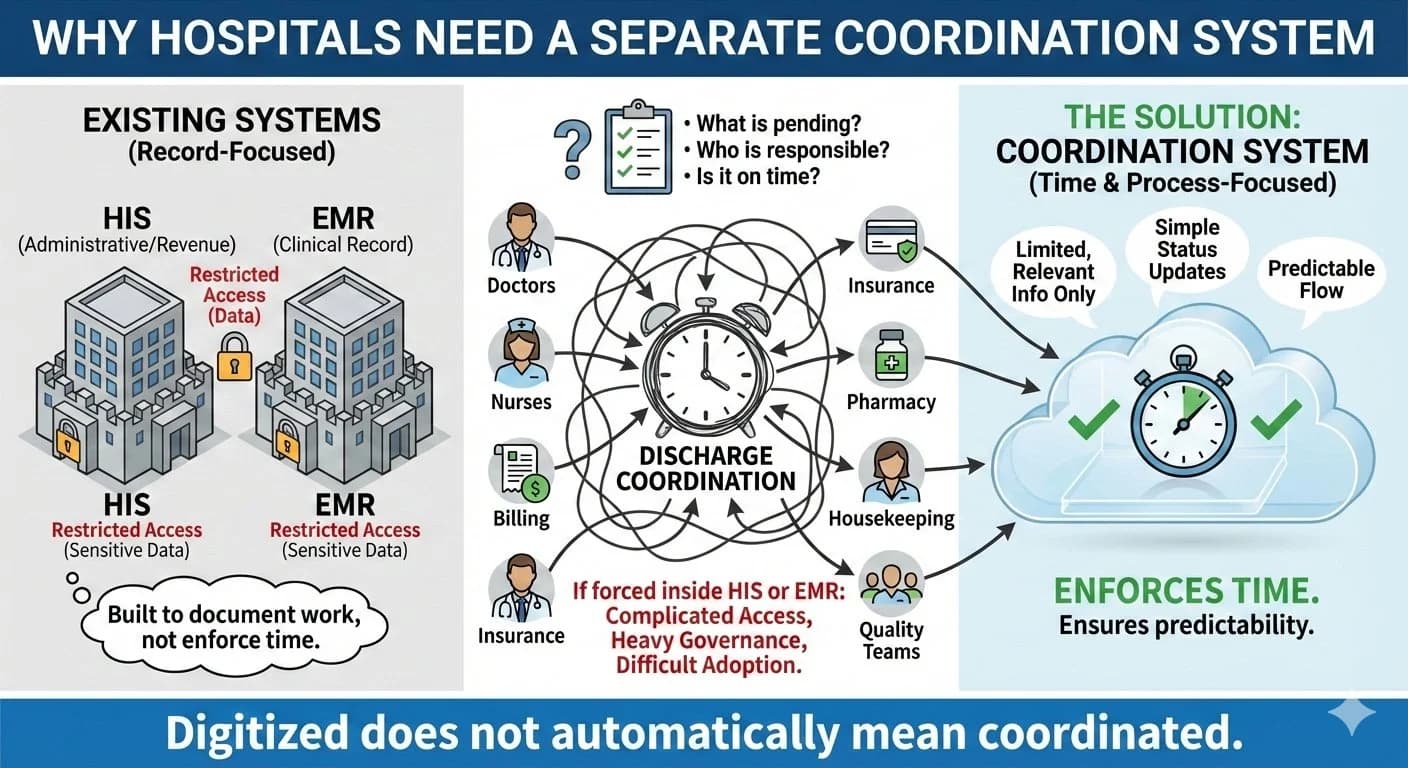
Why Coordination Cannot Live Inside HIS or EMR
HIS and EMR contain:
- —Financial data
- —Clinical data
Both constitute sensitive patient information.
Access must remain tightly controlled and role-restricted.
But coordination involves every role:
- —Doctors
- —Nurses
- —Billing
- —Insurance
- —Pharmacy
- —Housekeeping
- —Quality teams
Many of these roles do not require full access to financial or clinical records. They require visibility into task status.
Embedding coordination deeply inside HIS or EMR increases governance complexity and expands access surfaces.
Coordination must remain:
- —Operationally visible
- —Frictionless to use
- —Fault tolerant
- —Structurally separate
That separation is not a limitation.
It is right architecture.
What HCS Does
What HCS Does That Record Systems Do Not
HIS and EMR record events. HCS enforces action.
Specifically, it:
- 01Enforces Turnaround Time (TAT)
Each discharge activity has a defined time expectation. The clock runs until completion.
- 02Sends Persistent Reminders
Tasks do not disappear into dashboards. They trigger structured reminders until closed.
- 03Escalates Delays Automatically
If a task breaches its time limit, escalation is system-driven — not phone-call driven.
- 04Synchronizes Departments
Departments are activated in parallel. Dependencies are visible. Ownership is explicit.
- 05Provides Shared Live Visibility
Every stakeholder sees where the discharge stands, what is pending, who owns it, and whether it is delayed. No chasing. No guesswork. No anecdote.
The Core Distinction
Documentation Is Not Coordination
Digitization solved documentation. It did not solve synchronization.
You can have
- · Complete EMR documentation
- · Accurate HIS billing records
And still have
- · Unpredictable discharge
- · Delayed bed turnover
- · Informal escalation culture
Because coordination requires time authority — not just record authority.
The Product
ChatOps.health
ChatOps.health is a coordination platform purpose-built to function as a Hospital Coordination System (HCS).
It works alongside your HIS and EMR.
It does not replace them.
It completes the stack.
The Result
The Result
When coordination becomes system-enforced:
- →Discharge becomes predictable
- →Variability reduces
- →Follow-up culture declines
- →Operational transparency improves
- →Leadership gains real-time visibility
Hospitals do not lack effort.
They lack synchronized action.
That is what HCS provides.
See ChatOps.health, the Hospital Coordination System, in action.
Deployed alongside your HIS and EMR for predictable discharges.
Request a Demo